Featured
Table of Contents
That maximizes money in the brief term, and you may have 3 to four years to conserve towards the settlement quantity. Very dangerous to credit rating, mainly due to missed out on payments and an adverse "resolved" mark that can stay on your credit history report for approximately 7 yearsMay be just alternative if other choices (financial debt consolidation, equilibrium transfer bank card, debt forgiveness) aren't possibleTypically requires a fee to the 3rd party, which could offset some or every one of the cost savings from financial debt settlementMay aid you avoid bankruptcy if you've missed out on several paymentsNot all lenders work with debt settlement companies Financial obligation mercy may be best for you if you are experiencing a financial hardship that makes it almost impossible to pay down your debt balances.

With a DMP, you make one monthly payment to the credit rating counseling firm. Those funds are then dispersed to lenders of your unprotected financial obligations, such as bank card and installment car loans. The agency deals with your lenders to lower rate of interest or forgo fees, but some financial institutions might reject such concessions.
A financial debt consolidation funding combines your eligible financial obligations right into one brand-new funding. It can assist you pay down financial obligation if you have the ability to safeguard a funding rate that's less than the typical price of the accounts you're combining. Nonetheless, you need to avoid racking up debt on those freshly cleared accounts or your financial obligation could grow also greater.
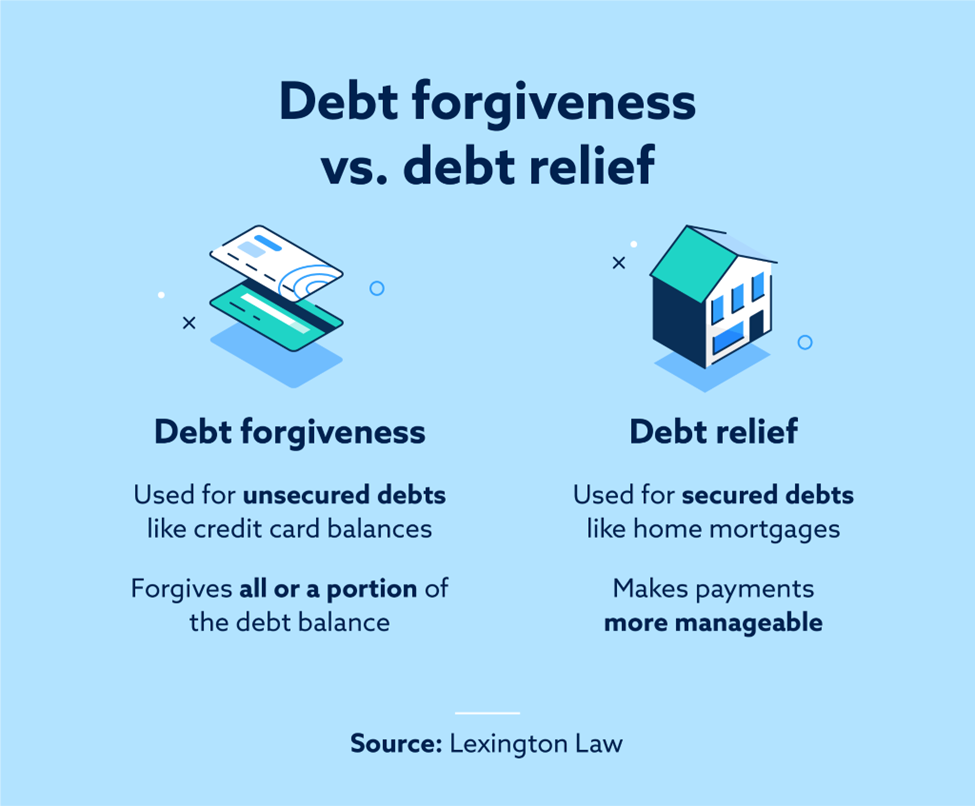
That gives you plenty of time to get rid of or dramatically lower your balance while making interest-free payments.
8 Easy Facts About What the Law Says When Pursuing Bankruptcy Counseling Described
You might require it if your lender or a collection company ever before attempts to gather on the debt in the future. The letter might show you do not owe what the debt collection agency's records show. Yes, in a lot of instances, the IRS takes into consideration forgiven financial obligation as gross income. When a loan provider forgives $600 or even more, they are called for to send you Kind 1099-C.
Financial debt forgiveness or settlement almost constantly harms your credit scores. Anytime you settle a financial obligation for less than you owe, it may appear as "worked out" on your debt report and influence your credit history for seven years from the date of settlement. Your credit score can likewise go down substantially in the months bring about the mercy if you fall back on settlements.
Frequent Misconceptions Surrounding Rebuild Credit Fundamentals Explained
Tax financial obligation compromise programs Tax obligation financial obligation occurs when the amount of taxes you owe exceeds what you have actually paid. This situation often arises from underreporting income, not submitting returns on time, or discrepancies discovered throughout an internal revenue service audit. The repercussions of accumulating tax debt are major and can include tax obligation liens, which provide the internal revenue service a legal claim to your residential property as safety and security for the financial obligation.
Higher rate of interest on offered credit report. Earnings and Financial institution Accounts IRS can levy (confiscate) wages and savings account to please the debt. Reduced income and interruption of essential monetary procedures. Residential or commercial property Seizure In severe cases, the IRS can seize and offer residential property to cover the financial debt. Loss of useful assets and possible variation.
Clinical depression, anxiousness, and various other mental wellness problems. Social Stigma Encountering lawsuit from the IRS can lug social stigma. Damages to reputation and partnerships. Employment Opportunities A bad credit report as a result of strain financial obligation can limit employment possibility. Trouble finding or maintaining a job. Government Benefits Tax obligation financial debt might affect qualification for government benefits, such as Social Safety and Medicaid.
Economic Uncertainty That Affect Increased Need for Debt Forgiveness for Dummies
The OIC thinks about numerous aspects, consisting of the taxpayer's earnings, expenses, possession equity, and capacity to pay. Successfully bargaining an OIC can be intricate, requiring a thorough understanding of the internal revenue service's standards and a solid disagreement for why your deal lines up with your capability to pay. It is very important to keep in mind that not all applications are approved, and the process calls for in-depth economic disclosure.
The internal revenue service assesses your general financial circumstance, including your income, costs, asset equity, and capacity to pay. You should additionally be existing with all declaring and settlement requirements and not be in an open personal bankruptcy case. The internal revenue service also considers your conformity history, examining whether you have a document of timely filing and paying tax obligations in previous years.
Rebuilding Personal Financial Standing the Right Way - Questions
The application procedure for an Offer in Concession includes a number of thorough steps. You should finish and submit IRS Type 656, the Deal in Concession application, and Type 433-A (OIC), a collection information declaration for individuals. These types need thorough financial details, including details concerning your revenue, debts, expenses, and possessions.
Back tax obligations, which are unsettled tax obligations from previous years, can considerably increase your overall internal revenue service financial obligation if not dealt with immediately. This financial debt can build up rate of interest and late payment fines, making the initial quantity owed a lot larger gradually. Failing to pay back tax obligations can lead to the internal revenue service taking enforcement actions, such as issuing a tax obligation lien or levy versus your residential or commercial property.
It is necessary to address back tax obligations immediately, either by paying the full amount owed or by setting up a repayment strategy with the internal revenue service. By taking proactive actions, you can prevent the build-up of additional rate of interest and penalties, and protect against much more aggressive collection activities by the IRS.
One usual reason is the idea that the taxpayer can pay the complete quantity either as a round figure or with a repayment strategy. The IRS also thinks about the taxpayer's revenue, expenditures, asset equity, and future earning capacity. If these variables suggest that the taxpayer can pay for to pay even more than the provided amount, the internal revenue service is most likely to decline the offer.
How Financial Implications Fees for Rebuild Credit can Save You Time, Stress, and Money.
Dealing with Internal revenue service financial debt can be complicated and overwhelming. Tax obligation professionals, such as CPAs, tax obligation attorneys, or enrolled representatives, can offer very useful help.

Table of Contents
Latest Posts
Rumored Buzz on Legal Aspects in The 12 Most Common Myths About Debt Relief—Busted by Real Counselors : APFSC
Little Known Questions About How to Get Started with Your Debt Forgiveness Journey.
Little Known Questions About Warning Signs While Researching a Debt Counseling Provider.
More
Latest Posts
Rumored Buzz on Legal Aspects in The 12 Most Common Myths About Debt Relief—Busted by Real Counselors : APFSC
Little Known Questions About How to Get Started with Your Debt Forgiveness Journey.
Little Known Questions About Warning Signs While Researching a Debt Counseling Provider.